Friday, September 20, 2019

Belgium honors 75 years of freedom as tanks roll into Mons

Each year in Mons, Belgium Allied tanks roll through the city to mark their liberation from the Nazis in 1944
(Courtesy: battlefield-tours)
MONS, BELGIUM — As the hearts and souls of Americans reflected upon the senseless acts of terrorism that took the lives of 3,000 innocent people on the morning of 9/11/01 some 18 years ago, tanks were rolling along the cobblestone streets of Mons, Belgium, just nine days earlier to commemorate the liberation of the city from the grip of Adolf Hitler's tyrannical quest for Nazi oppression in 1944.

It's a local tradition that takes place in Mons each year to pay tribute to the reborn independence from the shackles of German dominance and brutality.

Liberation of Mons, 1944
(Photo: us.army.39.45.soforums.com)


This year however, September 2 was more special than usual because it marked the 75th anniversary of that glorious day when Belgians were once again free. To honor the occasion, tanks annually roll into Mons as a way of saying thank you to American soldiers and their allies and to keep the flame of independence alive by letting the world know that they have not, and will not, ever forget the sacrifices made on their behalf in the mid-20th century.

While many people have never heard of Mons, the city became the focus of a popular World War I legend, that, like all good folklore, continues to grow more than a century later.

It happened in late August 1914 when the first major engagement of the British Expeditionary Force in the First World War occurred at the Battle of Mons.
Mons is free once more
(Photo: us.army.39.45.soforums.com)


Advancing German 
forces were thrown back by heavily outnumbered British troops, who suffered heavy casualties and, being outflanked, were forced into rapid retreat the next day. The retreat and the battle were rapidly perceived by the British public as being a key moment in the war.

Inspired by accounts he had read of the fighting at Mons, Welsh author Arthur Machen published a short story entitled "The Bowmen" for the London newspaper the Evening News on September 29, 1914.

Though Machen's story was pure fiction, it was not labeled as such when it was published and, because he had written several legitimate war stories previously for the paper, many readers took it to be a true account.

Town Hall in Mons, Belgium is a popular year-round
gathering spot 
(Photo: Pixabay)
Further complicating the problem was the fact that Machen frequently wrote in the first-person in order to create the illusion of being an eye-witness. A technique which further added credibility to his imaginary tale at Mons.

Much like Orson Welles with his Halloween radio broadcast of The War of the Worlds (1938), Machen had no desire to create a hoax, but the fuse had already been lit.

In "The Bowmen" Machen's soldier saw "a long line of shapes, with a shining about them." Writing in the Occult Review, A.P. Sinnett, stated that "those who could see said they saw 'a row of shining beings' between the two armies," which led Machen to suggest that the bowmen of his story had become the "Angels of Mons." 

The Angel of Mons pays homage to a World War I legend created
by Arthur Machen

(Photo: David Dixon -- licensed under the Creative Commons Attribution 2.0 Generic license)

Before long, variations of the story began to appear as authentic histories, including one account describing corpses of two German soldiers with arrow wounds that had been found on a battlefield.

In April 1915, an account in the British Spiritualist magazine told of a mysterious force that had miraculously intervened to help the British during the decisive moment of the battle.  This quickly resulted in a flurry of similar stories and the spread of wild rumors, the most popular version of which grew to describe the saviors of the British soldiers as angelic warriors.

Church organ in Mons
(Photo: Pixabay)
By May, a full-blown controversy had erupted, with the angels being used as proof of divine providence on the side of the Allies in sermons across Britain before spreading to newspaper reports published throughout the world.

In an effort to end the gossip, Machen republished his fable in August in book form, with a long preface detailing that the rumors had begun with his original story.

Unexpectedly, the book became a bestseller, resulting in a large series of other publications claiming to provide evidence of the Angels' existence.

The sudden spread of misinformation in the spring of 1915, six months after the events and Machen's story was published, is difficult to explain. The most detailed, and popular, examination of the Mons story comes from  David Clarke which suggests the men may have been part of a covert attempt by military intelligence to spread morale- boosting propaganda and disinformation.

With the sinking of the LusitaniaZeppelin attacks and failure to achieve a breakthrough on the Western Front, it was a difficult period of doubt and low morale for the troops. Thus, the timing would make military sense.

Some of the stories went so far as to claim that sources could not be revealed for security reasons.

The Belgian royal family walking in Mons on occasion of 100 years of independence (1830 - 1930)
(Photo:  Lensens, Mons -- Public Domain --PD-1996)

The most detailed study of the event suggests that Machen's story provided the genesis for the vast majority of the tales. which clearly boosted morale on the home front, as popular enthusiasm had been eroding in 1915. In that regard, the Angels of Mons were every bit as real as people believed them to be.

Three decades later, the angels returned in the form of tanks and soldiers to liberate Mons and Belgium once and for all. In tribute the tanks now return every September, just as Bob Hope used to do in war zones each Christmas.

As Hope might have said to the citizens of Mons, "Tanks for the memories."

Americans would do well to observe the message learned from Mons, for just as they "have not forgotten", on 9/11 each year, neither should we.


Friday, September 13, 2019

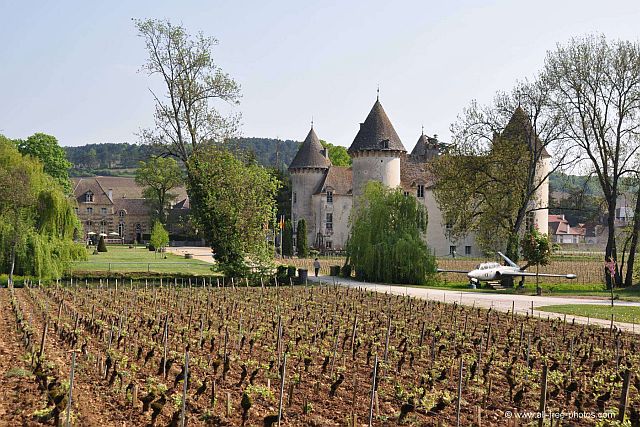
World's largest private collection of vintage fighter jets at Château de Savigny-lès-Beaune

Château de Savigny-lès-Beaune is home to the world's largest
privately owned fleet of vintage of vintage fighter jets
 (Courtesy: Château de Savigny-lès-Beaune)

SAVIGNY-LES-BEAUNE, FRANCE — At the ripe young age of 87, Michael Pont has become a collector's collector. As owner of Château de Savigny-lès-Beaune in the Burgundy wine country of France for more than four decades, Michael Pont is the proud owner of the world’s largest private fleet of fighter jets according to the Guinness Book of World Records.

As if 110 war planes weren't enough to suit the flights of fancy for the eccentric former French air force pilot, he also owns a 1970s hovercraft, a warehouse of approximately 20 old firetrucks, some 200 antique motorbikes and 36 race cars.

Jet on front lawn of the castle
(Courtesy: Château de Savigny-lès-Beaune)
As with so many owners of large estates and castles in Europe and the United Kingdom, outlandish taxes often make it virtually impossible for proprietors to maintain their holdings, frequently stealing a family's personal legacies as well as treasured links to that of the country.

Consequently, land holders oftentimes resort to all manner of revenue producing ideas to preserve their heritage; vineyards, tours, museums, accommodations and, even, safari parks are among the money-making schemes.

When Michael Pont became interested in acquiring retired military aircraft, it was not initially his plan to turn his chateau into an outdoor museum, even though the property was only attracting about 50 to 100 visitors each year.


The Vought F 8 Crusader
(Courtesy: Château de Savigny-lès-Beaune)
Coming from a military background, the war plane collection was more an act of nostalgia to preserve the history of flight during important conflicts that altered the course of history.

Rather than watch the airborne relics be melted down and recycled into beer cans and the like, Pont decided to save as many of his flying friends as possible and, before long, he possessed a personal collection of vintage military aircraft that is second to none.

So dedicated did Pont become in his pursuit, that he recalls having to dismantle one aircraft by himself on a runway in Djibouti and then rebuilding it when he returned to the chateau.


Today the chateau attracts nearly 40,000 visitors each year
(Courtesy: Château de Savigny-lès-Beaune)
As a result of Pont's efforts, today Château de Savigny-lès-Beaune attracts about 40,000 visitors each year, including 35,000 paying customers.

Once he became "hooked", Pont searched high and low throughout Europe, including Russia, and Africa to find precious new additions for his prized collection.

Valet parking for a private fleet of 110 fighter planes
(Courtesy: Château de Savigny-lès-Beaune)
Whenever he found a new jet, Pont would hire a team of mechanics to lovingly dismantle the aircraft, before renting a crane to transport it back to France in pieces. 

In his youth, prior to joining the French military, Pont spent his time driving race cars, so his spirit of adventure and interest in all things motorized and mechanical comes naturally.

The original chateau dated to 1340
(Courtesy: Château de Savigny-lès-Beaune)
The chateau itself was built for the Duke of Eudes in 1340. A mere 138 years later, after the invasion of Burgundy by Louis XI in his conflict with Marie of Burgundy, the castle was dismantled. It wasn't until the early 17th century when it was restored.

In 1972, the property was purchased by a wine grower/operator of a nearby estate. Today, the 66 acre vineyard still thrives with some vintages that date as far back as 600 years.

Despite the success of the chateau's wine production, Michael Pont had the vision early on to realize the potential for his private air force since all military bases in France are off-limits to the public. His aircraft collection, therefore allows people to get up close and personal with historic planes, cars and other vintage vehicles that might otherwise be inaccessible to the average person.

Today many chateaus struggle due to heavy property taxes
(Courtesy: Château de Savigny-lès-Beaune)
When most people think of French chateaus, they conjure images of royalty, aristocracy, culture, literature, architecture, art and a history that is deep and rich.


Still ready for action
(Courtesy: Château de Savigny-lès-Beaune)
One thing they do not imagine however, is a living outdoor museum filled with 110 fighter jets, nearly 40 classic race cars, a collection of motorcycles and don't forget that hovercraft.

And that's the "plane" truth.

Friday, September 6, 2019

Deluxe tour of Italy in 2020 with The Magellan Travel Club

The seaside village of Amalfi along the breathtaking Amalfi Coast
(Photo:Taylor)
ITALYThe Magellan Travel Club is offering a deluxe tour of Italy in the spring of 2020 in honor of its 11th anniversary.

The itinerary includes accommodations in three of Italy's most popular 5-star hotels; Hotel Bernini (Florence), Hotel Santa Caterina (Amalfi) and The Hassler (Rome). Also included in the 11 day adventure are three lunches and two dinners prepared in four of Italy's finest kitchens in  indescribable settings in Amalfi, Positano, Ravello and Rome.

Guided tours are part of the package in Florence, the Chianti country of Tuscany and Pompeii. If time permits, we may also arrange a tour of the Sistine Chapel as well as St. Peter's Basilica.


Ancient street in Pompeii
(Photo: Taylor)
In addition, participants will enjoy day excursions to Positano, Ravello, Capri and La Posta Vecchia, the former villa of John Paul Getty. Yet with all of those activities, there will still be ample free time for individual sightseeing, shopping and, of course, relaxing.

How is it possible to do so much, and still have free time leftover? Simple. It's all a matter of planning, experience and knowledge of the destination. Add a group of enthusiastic, flexible and compatible travelers to the mix and you have a sure-fire once-in-a-lifetime travel experience filled memories you'll never forget.

The tour begins with a motorcoach transfer from Rome's Fiumincino Airport to Florence, the city of Michelangelo.


The earthtones of Florence at twilight
(Courtesy: visitflorence.com)
Though a bus transfer takes a little more time than the hour and a half journey by high speed train from Rome, it eliminates the hassle of jet-lagged travelers schlepping their luggage to connect to a means of transportation that is unsuited for dealing with the multiple bags of group travel.

Arriving in Florence in mid-afternoon, we check-in to Hotel Bernini, rated one of ten best lodging establishments in the city. The remainder of the day is free for self-orientation.

*TIP: Stay awake, if possible, eat a light early dinner and retire about 8:30 or 9:00 pm. You'll sleep like a baby and awaken refreshed and with no jet-lag after effects.

All breakfasts are included, so fill up at the buffet before heading on a guided morning walking tour.


Michelangelo's David, Florence
(Photo: Taylor)
*TIP: A guide is always a better way to do sightseeing, especially on a first visit to a destination and if you are traveling with a group where you can share the costs. Professional guides are licensed and will keep you on schedule without losing time by being disoriented. They are also knowledgeable so that many of your questions can answered immediately. Best of all, guides have the authority to bypass lines, which is a huge time-saver over independent travel.

The afternoon is free for personal exploration and shopping.

For shoppers in Florence, we suggest looking for leather.

Recommended sightseeing are stops at the Pitti Palace and Boboli Gardens, the Brancacci Chapel and the little known Officina Profumo-Farmaceutica di Santa Maria Novella (Pharmacy of Santa Maria Novella).

Dusk on the Arno River and the Ponte Vecchio
(Courtesy: visitflorence.com)
At twilight, go across the Arno River for a relaxing drink before dinner at Piazzale Michelangelo. Here you can view ever-changing patterns of earthtones and mist at sunset.

But the adventure has only just begun.

Day two includes a guided motorcoach tour into Chianti country for a wine tasting or two and visits to some popular Tuscan villages such San Gimignano which was featured in the 1999 movie Tea with Mussolini.


Hotel Santa Caterina, Amalfi
(Photo: Taylor)
Now that we are savvy, rested travelers, it's time to tackle the Italian high speed rail system which will whisk us through Rome and on to the main railway station in Naples where will be picked up and transferred by coach to the delightfully friendly ambiance of the 5-star Hotel Santa Caterina in Amalfi.

Here is where we immerse ourselves into all things lemon, including the popular local drink known as limoncello.

*WARNING: Amalfi is addictive, as is our hotel. You may never want to leave! We assume no responsibility.


Stairway to paradise in Amalfi
(Photo: Taylor)
After a free afternoon of exploring Amalfi and Santa Caterina on your own, we suggest you rise early for a spectacular included breakfast buffet on the veranda with a perpetual face toward the sea thanks to its southern exposure.

We then take a boat to Positano and disembark for shopping and browsing through narrow streets and alleyways filled galleries and boutiques.

The once sleepy fishing village now thrives with energy after author John Steinbeck fell under its mesmerizing spell and wrote about it.


Positano as seen from Hotel San Pietro
(Courtesy: ilsanpietro.it)
Steinbeck wasn't the only celebrity to become enraptured by the hypnotic  allure of the Amalfi Coast. So too, did Greta Garbo, Gore Vidal, D.H. Lawrence, Richard Wagner, Brad and Angelina and Richard Burton and Elizabeth Taylor among dozens of other international celebrities.

Hillary and Chelsea Clinton even "roughed it" one night when they stayed at Santa Caterina.

San Pietro is almost invisible unless you know where to look
(Courtesy: ilsanpietro.it)
Our included lunch will be at the spectacular invisible Hotel San Pietro, just a mile and a half down the coast from Positano.

San Pietro is recessed into the rock, making it almost "invisible" from either the road or the sea, unless you know where to look.

After a breathtaking mid-afternoon transfer back to Amalfi along the coastal road, the remainder of the day is free for a swim in the pool, a nap or a stroll through the hotel's lemon groves.


Vesuvius destroyed Pompeii in
79 A.D.  (Photo: Taylor)
The following day includes a guided walking tour of the ruins of Pompeii. Note, Pompeii is quite large, so don't expect to see it all. It will also be about ten degrees warmer than Amalfi.

Upon our return, head to the village for shopping and/or gelato or just chill out at the hotel before enjoying the first of two included dinners at our hotel.

Ravello, with its stunning views and pair of villas, Ruffalo and Cimbrone, are next on the agenda. Stay as long as you like and return to Amalfi at your leisure.


Lunch at Hotel Palumbo, Ravello
(Courtesy: hotelpalumbo.it)
Lunch is included at Hotel Palumbo, a one-time medieval palace dating to the 12th century. Believe it or not, the views from Palumbo are among the most stunning on the Amalfi Coast. Also be sure to thumb through the pages of the guest book -- you may never wash your hands again.


*TIP: Upon arriving in the main square of Ravello, most people turn left to stroll past shop after shop of ceramics. Unless you take time to visit Vietri, Ravello is the best place for ceramics. That said, we suggest that you walk in the other direction as well. Many visitors do not, and shoppers miss some of the best bargains and highest quality ceramics in town. Sightseers also risk bypassing some of the  most majestic scenery along the Amalfi Coast.

Our last day in Amalfi includes an optional full day boat excursion to Capri, once the decadent playground of many Roman emperors. Caligula, in particular.


Harbor at Capri
 (Photo: Taylor)
Today, Capri is a home for decadent shopping instead. Non-shoppers may want to visit the famed Blue Grotto. We also suggest that you also take the local bus up to Anacapri, the highest point on the island.

Those who stay back can enjoy the hotel, do last minute shopping or ride along the coast to Atrani for ceramics or Vietri for tiles.

Tonight we enjoy a scrumptious included four-course farewell dinner at the hotel.

If you can tear yourself away, we have an early morning transfer to Naples where catch the high speed train to Rome.


Hotel Hassler at the top of the Spanish Steps is our home in Rome
(Courtesy: hotelhasslerroma.com)
Our last hotel is the Hassler, which is to Rome what the Waldorf-Astoria is to New York. The Hassler however, sits at the top of the Spanish Steps.

The reason for leaving Amalfi early is to allow as much free time as possible to explore Rome on your own.

*TIP: Since dinners in Rome are on your own, we recommend doing at least one of them in Trastevere. Situated on the other side of the Arno River, this is the place where locals hang out. Just ask the concierge for a suggestion or two.


Farewell lunch at La Posta Vecchia, once John Paul Getty's villa
(Courtesy: pellicanohotels.com)
Our final outing is a short bus trip to the former villa of John Paul Getty. Getty discovered and excavated ancient Roman ruins beneath the floor of La Posta Vecchia (Old Post Office), thereby literally turning his home into a museum.


Ruins dating to Julius Caesar
(Courtesy: pellicanohotels.com)
We are able to browse the grounds before and after our included lunch prior to returning to Rome for last minute shopping and dinner.

Today, we say Arrivederci to Italy, knowing full-well you will return even if you didn't toss a coin into Trevi Fountain.


Indoor pool at La Posta Vecchia
(Courtesy: pellicanohotels.com)
Space is limited and deposits of $500 per person are due by Friday September 20 since any uncommited rooms must be released.

For details click on this link at Magellan Travel Club

Even old Magellan would have enjoyed this trip enough that he might never have gone round the world either.


Friday, August 30, 2019

Six fantastic new bicycle tours for 2020 with VBT


And so the adventure begins, cycling through the Euopean countryside where new discoveries await  (Courtesy:vbt.com)
WILLISTON, VERMONT Whatever your individual lifestyle may be, there are dozens of ways to see the world and to immerse yourself into the fabric of a destination. There's a travel opportunity waiting just around that suits your personality.

Since 1971, adventurous travelers seeking something faster than walking and more in depth than motorcoach tours have been discovering VBT Bicycling Vacations.


VBT handles everything, all you
do is ride and enjoy
(Courtesy:vbt.com)
With more than 50 deluxe, small group bicycling, walking and waterways “bike & boat” vacations, each VBT trip includes all accommodations, most meals, two local bilingual Trip Leaders, unique facilitated cultural experiences and vehicle support. VBT also includes round-trip international airfare from over 30 U.S. cities and select Canadian cities for all international vacations.

Rated among the “World’s Best Tour Operators” by Travel & Leisure for eight years, VBT offers unique itineraries and experiences at unsurpassed value throughout the world.


Cathédrale Saint-André de
Bordeaux (Courtesy:vbt.com)
From bucket-list destinations to the world’s hidden gems, six new VBT itineraries explore the coastlines of British Columbia and France, the English countryside, the Baltics, and the scenic banks of the Rhine through the heart of Europe to the Italian Riviera.

Meet new people, make new friends while cycling with VBT 
(Courtesy:vbt.com)

British Columbia: Vancouver Island and the Gulf Islands: Island-hop along Canada’s west coast by bicycle, ferry and sea kayak. Begin in Sidney, along the shores of the Salish Sea on the Saanich Peninsula, exploring art galleries, studios, public sculptures, local cheeses and ales in Salt Spring and Pender Islands. Keep a keen eye out for dolphins, sea lions, killer whales and seals.

Pedal the Galloping Goose Trail from the Swartz Bay Ferry Terminal to Victoria, through fields of golden corn, parks and forests and ride along the coast with stunning views of the Pacific Ocean and Olympic Mountains.


Butchart Gardens, Victoria, BC
(Courtesy: Public Domain
Pictures)
If Wild Pacific Salmon and Dungeness crab are to your liking, prepare for the feast of a life time.

Extend your stay in Victoria and be sure to visit the magnificent Butchart Gardens.


Departures: May through October; prices begin at $3,745 per person, double occupancy including roundtrip flights.


Do a personal Tour de France without the competition
(Courtesy: vbt.com)
France: Bordeaux to La RochelleDiscover France’s Atlantic coast while cycling through historical towns including one of the “Most Beautiful Villages in France,” Talmont-sur-Gironde. Explore troglodyte caves carved into the limestone cliffs at Meschers-sur-Gironde.

With VBT, the world is 
your oyster 
(Courtesy: marennesoleron.com)

In the Marennes-Oleron region, cyclists learn firsthand why the oysters of the area  are considered some of the tastiest in the world.

The itinerary also includes a visit to the well-preserved, fortified town of Brouage, birthplace of Samuel de Champlain.

Savor the Belle Epoque villas of the seaside town Fouras-les-Bains and enjoy a walking tour of La Rochelle.

Departures: April through October; prices begin at $4,395 per person, double occupancy including roundtrip flights.


The Cotswolds are not only charming, they're ideal for cycling
(Courtesy: vbt.com)
England: Bath & the Cotswolds: From Bourton-on-Water to Chipping Campden, the road less traveled wends its way through hedge-lined country lanes into handsome sandstone villages celebrated for their timeless charm and thatched roof cottages.

Stroll the footpaths of Hidcote Gardens, one of England’s most influential Arts and Crafts gardens, and explore the medieval stone buildings of Burford.


Bath's Royal Crescent
(Courtesy: Pixabay)
Ride into 17th-century market towns and explore the architectural splendor of Bath's Royal Crescent where the concept for condominiums originated.

Not to miss are the Roman baths, Pulteney Bridge and the Doll Museum before pedaling on to Bleinham Palace to tour the birthplace of Winston Churchill.
 
Departures: May through October; prices begin at $5,495 per person, double occupancy including roundtrip flights


Cruising the Rhine past the Lorelei
(Photo: Taylor)
Rhine Bike & River Cruise: Basel to Amsterdam: Explore four countries – Switzerland, France, Germany and the Netherlands – on a single, all-inclusive European river cruise enhanced by scenic and easy cycling, guided tours and more.

Cruise through the heart of Europe, viewing terraced vineyards, quaint riverside towns and lofty castles before disembarking along the way to view them up close by bike.


Dusk in Heidelberg 
overlooking the Neckar River 
(Courtesy: rhine-moselle.com)
Alsace is a popular wine region in France’s famous Route des Vins. Travelers also experience the emotional legend of the Lorelei while cruising the majestic Rhine Gorge in Germany.


Cruise past medieval cities and trace the route of ancient Romans and knights. Explore the historic cities of Strasbourg, Heidelberg, Koblenz and Cologne before discovering the delightful canals of Amsterdam.

Departures: May through September; prices begin at $5,695 per person, double occupancy including roundtrip flights


A short break before "easing on down the road" 
(Courtesy: vbt.com)
Lithuania & Latvia: The Baltics: For experienced wanderlusters who have visited many of the more traditional places in Europe, Lithuania and Latvia provide centuries of history from pagan days to the post-Soviet era.

Enjoy a private cruise to the Curonian Spit, a UNESCO World Heritage Site and view some of the world’s largest pieces of amber on a guided tour of Lithuania’s Amber Museum.


Contemplating a dip before
moving on
(Courtesy: vbt.com)
Delve into Soviet history on a tour of the Cold War Museum, situated in a former underground missile site. Later, spin around Lake Plateliai in the Žemaitlia National Park, another UNESCO site.


VBT cyclists also sample local life with a visit to an organic herb farm and an authentic Lithuanian barbecue.

Departures: May through October; prices begin at $4,095 per person, double occupancy including roundtrip flights


La Morra Vineyards, Piedmont Italy are part of the package
(Courtesy: vbt.com)
Italy: Piedmont, Langhe & the Riviera: There's  no question that when it comes to good taste, Italians will find something that tastes good. This is a ride into Italy’s renowned culinary culture where cyclists traverse the sloping vineyards of Piedmont and the breathtaking coast of Liguria.

Cycling through Europe with
VBT is a bold new adventure
(Courtesy: vbt.com)

Sample Barolo, Arneis and Favorita wines and local cheese, learn to prepare authentic pesto from a culinary expert and go truffle hunting with a farmer and his trusty dog during a stay at an authentic agriturismo. Visit the internationally renowned University of Gastronomic Sciences and explore Taggia, one of the most beautiful villages of Liguria and its ancient Dominica convent.

Departures: May through October, prices begin at $4,045 per person, double occupancy including roundtrip flights

For more information about VBT Bicycling Vacations call 800-245-3868 

Why not let VBT take you for a ride? It's all just part of the "cycles" of life and great for the environment as well, because once you travel with VBT, the next thing you'll want to do is "recycle."