Friday, December 8, 2017

Great small towns in Italy (Part I)

Atrani is Italy's second smallest city but it has big rewards
(atrani.it)

ITALY — A wise traveler once wrote that "every place is undiscovered until you discover it yourself." No matter how famous or unknown, regardless of size, until the experience becomes your own, it exists only in your imaginations.

Many favorite villages are
coastal towns (Taylor)
Savvy travelers are always searching for hidden gems to satisfy their wandering curiosity. Many destinations offer countless unknown charming spots that can capture your heart, but no country in the world does it better than Italy.
Dramatic Amalfi Coast
(Taylor)

In a recent edition of the online version of "Conde Nast Traveler" the popular magazine listed the Italy's ten best kept small town secrets. 

Today we offer five of the ten with the other five to follow next week in the hope they will either establish new places for you to visit or allow you to bust your buttons with pride to learn that you, too, "discovered" them on your own.

Atrani as seen from the heights of Ravello (atrani.it)


Atrani: Every place along the Amalfi Coast is "just around the corner" which means that Atrani, the second smallest town in Italy, is often overlooked by travelers en route to the larger, better known towns of Amalfi, Positano and Sorrento.

Actually, Atrani can be viewed from the heights of Ravello along with two of its sister villages, Maori and Minori.

Nestled between two cliffs overlooking the Tyrrhenian Sea, Atrani offers top quality ceramics, splendid churches, lively piazzas and an abundance of family-operated trattorias.

And, like we said, it's just around the bend from Amalfi.

Saluzzo was mentioned in two major literary works
(wikipedia.org)
Saluzzo: Though it may sound like one of the families from "The Godfather", the quiet medieval village of Saluzzo is situated just an hour south of Turin by car.


Tiny as it may be, Saluzzo is the setting in at least two major literary works; Boccaccio used it in the final story of the "Decameron" and it was also the site of the "Clerk's Tale" in Chaucer's "Canterbury Tales.''
Cathedral of the Virgin Mary in
Saluzzo  (en.wikipedia.org)
Famous for it red-tiled roofs, bell towers with their ancient spires and the snow-capped Cottian Alps, the city of Saluzzo is built on a hill overlooking a huge, well-cultivated plain that is chock full of natural resources.

Collodi eases down its hillside live a river of buildings
(en.wikipedia.org)
Collodi: All you need to know about Collodi is that it is famous for being the home of Pinocchio's creator Carlo Collodi. Dating to the 12th century when the castle was built for defense, Collodi cascades down a hillside like a stream of stone. 

This lovely medieval town which is situated in Tuscany between Florence and Pisa, is noted for its homage to the little wooden boy with the tallest Pinocchio statue in the world.

The Garzoni Gardens with its Renaissance statues and stunning fountains are close by in the event that mechanical wooden puppets and talking crickets have no appeal.

Castelluccio is famous for its rainbows of color
(en.wikipedia.org)
Castelluccio: At 5,000 feet above sea level, Castelluccio is the highest community in the Apennines. Though relatively unknown to every day tourists, skiers and trekkers are familiar with the village during the appropriate seasons.

The town dates from the 13th century but the Romans settled there much earlier. Two major seismic events in Central Italy in 2016 and earlier this year, destroyed more than 50% of the settlement but it has recovered nicely and is once again a thriving agricultural destination.


Fields of wildflowers add to the charms of Castelluccio
(en.wikipedia.org)

Castelluccio is famous for its lentils and fields which create a kaleidoscope of colors during the spring/summer "flowering season." Arguably the most beautiful village in the Apennine Mountain Range, Castelluccio also features numerous picturesque piazzas that compliment its beautiful church.

Panoramic view of Monte Isola  (wikimedia.org)

Monte Isola: Sometimes the best discoveries are those that take a little effort to reach. Part of the reason, of course, is their inaccessibility, and Monte Isola fits the bill. Not only is Monte Isola the largest lake island in Italy, it is also the biggest in South and Central Europe.

To get there requires an hour and a half drive from Milan followed by a 20-minute ferry ride across the lake to the town of Iseo, which is also the name of the lake. There is also regular ferry service to the main ports of Carzano and Peschieria.

Floating piers at Monte Isola  (wikipedia)


Filled with quaint lakeside cafes and trattorias as well as delightfully comfortable B&Bs, Monte Isola is one of those places that immediately captures your heart.

Visiting the beautiful chapel shrine of Madonna della Ceriola, is also a bit of a challenge. At just under 2,000 feet, on the highest point on the island, Madonna della Ceriola can only be reached by walking from the tiny village of Cure.

If this quintet of charming little-known destinations whets your appetite for the magic of Italy, take a deep breath and wait one more week to learn about the next five on the list.

Friday, December 1, 2017

Skiing at night in the Swiss Alps


Night shrouds Nendaz in glittering lights (nendaz.ch)
SWITZERLAND Ol' Man Winter is heading this way, and in Switzerland, that means ski season is set to begin.

There's only one thing better than skiing in Switzerland and that is skiing in Switzerland at night where you can turn yourself into a human comet as you make your way down the slopes.
St Moritz is a year-round resort where ski season begins early
(wikipedia)
When the sun goes down and the sky is clear with a full moon to guide the way, it's "dancing with the stars" Swiss-style as a distant village looms ahead where a crackling fire and hot toddies await.
Hairpin turn on the ski slopes at St Moritz (stmoritz.ch)
St. Moritz is a good place to begin where night fun gets underway on Fridays at 7 pm in Corvatsch. At 2.5 miles, the Corvatsch Chastelets slope is the longest floodlit run in the country.

No need to do it all in one fell swoop however. There's a wood-fired oven at the Murtel middle station where pizza and hot chocolate will recharge your batteries for the final run into the village.
Heading for Hossa Bar
(stmoritz.ch)
The apres-ski meeting place to be is the famous Hossa Bar where locals and visitors gather during the Friday "Snow Nights" between 7 pm and 2 am. With a menu featuring huge burgers, chicken wings and hot dogs done to American-style perfection this is the place to be.

If you decide not to ski the entire run, the only thing to remember is that the last cable car departs at 1:40 am.

St Moritz offers more than its share of winter activities with lively festivities throughout the season. You can even play snow golf or place bets on horse racing on one of the frozen lakes.
Ski by the light of the silvery moon in Nendaz (alpenwild.com)
Nendaz may at first be an unfamiliar name to many, but once you experience the thrill of full-moon skiing in the Valais, it's a place you won't soon forget.
When the sun sets, Nendaz
comes alive (nendaz.ch)
The time-honored tradition begins at Tracouet mountain restaurant with a welcome drink and a themed dinner at 8 pm. An hour later, at 9, the Jean-Pierre ski run opens for moonlit trips down the illuminated slope.

Skiiers and spectators alike will find plenty of places to sip a cup of vin chaud, hot mulled wine, along with the romantic, haunting sounds of Alphorns and storytellers to boot.
Powdered tranquility
(nendaz.ch)
No need for non-skiers to despair, the Swiss think of everything. There's a gondola which makes regularly scheduled runs up and down the mountain to Tracouet.
 
Full moon guides the way to Arosa (rhb.ch)
One of the best year-round destinations in Switzerland, thanks in large part to its semi-remote location, is Arosa. Arriving by train from the town of Chur, Arosa is a typical alpine village nestled beside a small pond beneath a bowl of snow-capped mountains.
There's always a sled when you
tire of skiing  (wikipedia)
Go to bed early and rise before the sun comes up to be the first skier to make tracks on freshly groomed virgin snow. The Proschieri ski lift or the Statzertali chair lift open at 6:30 am to transport you to the Arosa Lendzerheide slopes.
Skiing and trains are synonymous in Arosa  (rhb.ch)
In winter the Swiss sun sleeps in, so the ski runs are illuminated early for those wanting to make tracks before sunrise.
The slopes beckon (rhb.ch)
After a hour or so of pre-dawn activity, the Alp Statz Restaurant will re-fortify you for the rest of the day with a delightful buffet breakfast.

Arosa is also a marvelous place to stroll at night with numerous cozy cafes, horse drawn sleighs and dancing fires to warm your soul after a day in the mountains.
Makin' tracks to Arosa for winter night skiing
(myswitzerland.com)
And don't forget, part of the fun of skiing in Arosa is the train ride to get there. Grab your skis, hop off the train and walk just a few yards to your hotel. It just doesn't get any better than that.

When night falls in winter in Switzerland, that's a signal to head for the slopes.


Friday, November 24, 2017

"We Love Normandy" and the best chateaux in the region

Mont St Michel is an island again thanks to a new causeway (wikipedia)

NORMANDY, FRANCE --What could be better than combining classic French cuisine with superb wine while relaxing in an elegant chateau? Add in a love of France and a marriage between a professional chef de cuisine and an award winning wine travel writer and it's a union made in heaven.
Chateau de Canisy is the quintessential French castle
(en.wikipedia)
Nicky and Patrick Hilyer have been living and working in Normandy, France since 2002. Nicky is the food expert, Patrick handles the wine. With nearly fifty years in the hospitality/tourism industry the couple has now created a first-rate website that is a must for any visitor to the Normandy region of France.
The Old Mill in Bayeux is
timeless (taylor)
"We Love Normandy" is a fantastic one-shop guide to one of the best known and most historic destinations in France. Nicky and Patrick offer everything from expert guide services to tips and information about what to see and where to go in Normandy.
American Cemetery at Omaha
Beach  (taylor)

In their inaugural issue of "We Love Normandy" the Hilyers have introduced readers to the top ten Chateaux of Normandy which we now proudly pass along to you.
Chateau des Ravelet was once the home of Alexis de Toqueville
(wikipedia)
Château des Ravalet: Jean de Ravalet purchased this former royal castle belonging to the French King, Francois I in the 16th century and built a Renaissance chateau on its medieval foundations. The history of Chateau de Ravalet is filled with murder, incest, bankruptcy and beheadings,  which make its secrets all the more intriguing.

By the 18th century, the castle became the property of the family of French diplomat, historian and aristocrat Alexis de Toqueville, author of "Democracy in America."

Now owned by the town of Cherbourg, the grounds are manicured by celebrated botanist Gilles Clement whose Mandala Garden and Island Meadow have won many prestigious awards.

The house is only occasionally open to visitors, but the park and gardens are open year-round.


Château des Ravalet, 50110 Cherbourg-en-Cotentin

Chateau de Canon is famous for its symmetry
(fr.wikipedia)
Château de Canon: This 18th century manor house was remodeled by noted Parisian lawyer and friend of Voltaire, Jean-Baptiste Elie de Beaumont. Along with his wife, Anne-Louise, the couple instituted the annual Fete des Bonns Gens -- the Good Folk Fayre -- a two-day festival of virtue that was held in the stables.

The French-style garden’s geometrical flower beds, elegant statuary and "mirror of water" lake reflect the perfect symmetry of the house. The remainder of the park, bisected by the River Laizon, was created in the English style at the turn of the 19th century. A guided tour of the house is available in July and August; the park is open from April to September.

Château de Canon, 14270 Mézidon-Canon
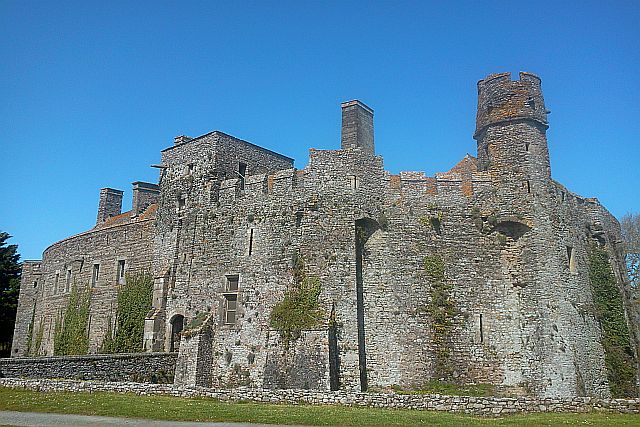
Chateau de Pirou features a replica of the Bayeux Tapestry
(wikipedia)
Château de Pirou: Viewing the pastoral serenity of Normandy today, it is difficult to imagine the turmoil of war that has ravaged so much of its history for the past thousand years. Chateau de Pirou, which dates to the 12th century, was built as a medieval fortress to protect the village of Coutances from invasions from the sea.

In the barn is an embroidered cloth, created in the 1970s in the style of the Bayeux tapestry, depicting the history of the Normans from Viking colonization to the conquest of Sicily. As with many ancient castles, Pirou has its legend: during a long siege, the Lord and his family escaped by transforming themselves into Geese.

Open every day except Tuesdays from April to September.

Château de Pirou, 50770 Pirou

The gates at Chateau de Brecy are its hallmark
(commons.wikimedia.org)
Château de Brécy: Built by a judge from the city of Caen, this 17th century property is noted for its exquisite gardens and ornamental gates designed by architect Francois Mansart.

The fabulous wrought-iron gates open to a series of terraces, a statue-adorned Renaissance knot garden with sculpted flowers, dogs and fountains and a medieval walled garden to which French author Jean de la Varende wrote, “opens to the sky."

Owners Didier and Barbara Wirth have been restoring the gardens since 1992. They open the gates to visitors from Easter until the end of May, then form July 1st to October 31st.

Château de Brécy, 14480 Saint-Gabriel-Brécy

Visiting Chateau de Canisy is like being at home in another
country  (taylor)
Château de Canisy: If ever a castle had the hallmarks of a French chateau, Canisy is the one. What makes this place extraordinary is its human story, however.

Canisy’s history began in the 11th century when one of William the Conqueror’s knights, Hugues de Carbonnel, constructed a Norman fortress near Saint-Lo. A dynasty was born that would last a thousand years: the present chatelain, Count Denis de Kergorlay, is De Carbonnel’s direct descendent.

During WW2 Canisy was sequestered by the Wehrmacht and used as an army hospital; after the liberation General Omar Bradley established his HQ at the château.


The castle sits in approximately 400 hundred acres of forest, pasture and landscaped parkland. The grounds are open year- round to visitors, the house by appointment. Eighteen guest bedrooms.

Château de Canisy, 50750 Canisy

Even Malcolm Forbes enjoys castle life at Chateau de Balleroy
(wikipedia)
Château de Balleroy: Built between 1626 and 1636, this château was the family seat of the Marquises of Balleroy for three centuries. In 1970, the property was purchased by Malcolm Forbes, and remains in the ownership of the Forbes family.

Arriving at the elegant gates, the imposing facade presents itself: a four-storied, cupola-topped edifice in grey granite and red pudding stone, flanked by two wings and a pair of pavillon lodges.

Surrounded by a landscaped romantic-style parkland and French knot gardens, Forbes, a ballooning enthusiast, also but a Hot Air Ballon museum that is well worth a visit, as is the parish church. Balleroy is open to visits from April to September.

Château de Balleroy, 14490 Balleroy
 www.chateau-balleroy.fr

The moat is the focus of attention at Chateau de Carrouges
(commons.wikimedia.org)

Château de Carrouges: An elegant twin-turreted gatehouse and decorative wrought-iron gates greet visitors to Château de Carrouges, a sombre moated castle built at the end of the 16th century. Other buildings were constructed as early as the 14th and 15th centuries. Inside you will find an interesting collection of furniture from the Renaissance to the Restoration, the kitchens with their copper pots, the bedchamber of Louis XI, fine fireplaces, ancient paneling and portraits and a fabulous brick staircase. The castle, park and gardens are open to visitors from April to September.

Château de Carrouges, 61320 Carrouges
www.chateau-carrouges.fr

You can call your bluff at Chateau de Falaise (wikipedia)

Château de Falaise: Named for the bluff that rises above the little town, Falaise was an important military site long before William, Duke of Normandy was born here in 1027. William spent his childhood at Falaise before going on to earn his moniker – William the Conqueror – following the battle of Hastings and the conquest of England in 1066.

Although the remains of the current castle (much restored between 1986 and 1996) date from a little after William’s time, the chateau’s military importance and historic significance are unsurpassed in the region being the birthplace of the first Norman King of England.

The town was devastated during the Battle of Normandy in 1944, but the castle is open every day except the month of January.

Château de Falaise, 14700 Falaise
www.chateau-guillaume-leconquerant.fr

Chateau de Fontaine=Henry is one of the best examples of Norman Renaissance Architecture (wikipedia)
Château de Fontaine-Henry: This dynastic castle was reconstructed in the 15th and 16th centuries in the decorative style. The facade is topped by steep, tiled roofs. Described by the French novelist Jacques de Lacretelle as “a Loire château in Normandy," Fontaine-Henry is one of the finest examples of Norman Renaissance architecture

Today the Marquis Pierre-Apollinaire d'Oilliamson welcomes visitors to his family seat. In the landscaped parc à l’anglaise is the 12th-century chapel, numerous outdoor games and, in summer, a sculpture exhibition. Open daily (except Tuesdays) from mid June to mid September, and on weekends and holidays in the shoulder periods.

Château de Fontaine-Henry, 14610 Fontaine-Henry
www.chateaudefontainehenry.com

We take poetic license with Mont St Michel because it is the most visited attraction in France  (fr.wikipedia)

Mont Saint Michel: We take poetic license with this one. Though not strictly a castle, this iconic marvel of medieval architecture has defended itself against invaders and tides since its foundation in the year 708. A UNESCO World Heritage Site, Mont Saint Michel attracts over 2 million visitors and pilgrims every year.  
   
Since the construction of a new bridge which replaced the causeway linking the citadel to the mainland, Mont Saint Michel is once again a magical island. Surrounded at high tides by the shimmering waters of the bay, when the tide is out this is a place of pilgrimage for visitors arriving on foot across miles of sand.

Mont Saint Michel is a must-see destination and justly deserves to be nominated the best castle in Normandy. Open every day throughout the year, and in the evenings from 7 pm until midnight during July and August.

Mont Saint-Michel, 50170


Planning a trip to Normandy? Looking for chateau or hotel accommodation? Visit We Love Normandy
